martes

Monday March 8th, 2010

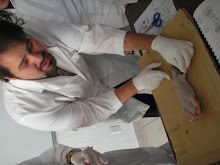
This class we talked about a particularily interesting kind of animalia, and they were:

· Sponges

· Cnidaria

· Platyhelmynths

· Nematode

· Annelida

Sponges (porifera)

These are nothing like the sponges you see on TV. These are completely still and unmoving, in fact they have calcium in them, so that tells you just how still they are.you may ask yourself, how do they feed then? Well its very simple. They clean water. Water rushes through them and as it does the sponge…does what a sponge does. Absorbs the nutrients it needs.

That’s just one kind of sponge though. The other kind uses flagella. 0.0 This one is not so still. It uses the flagella and spins it in order to make a whirlpool, and force or actually suck the water in.

Cnidaria (jellyfish-anemone)

These have 2 layers of skin, the outside one is used for protection, and the inner one is used for digestion.

Now you may know them as “aguamalas” but those are just one of the different species of jellyfish. Cool thing about these is that they can reproduce both sexually and asexually, one generation does it sexually and the next asexually. This is called alternance of generations. Now about the burns of these,they are caused by “nematocistos”, which are like stingers activated by a nerve when it is stimulated. Even when it dies, the trap set up will still work. Which is cool.

Not much to say about anemone. They are the house of clownfish (nemo), but actually have toxins and other stuff to trap little fish. They are stuck on the ground but can move their tentacles in order to trap its prey.

Platyhelmynths (flat worms)

These are the first to have a cephalic region, which is considered a head, a group of nerve cells.

They also have bilateral symmetry, which means they have a left and a right and a top and bottom…although they poop through their mouth.

They are turbellarians, meaning they eat microalgae

These also happen to have blood

And finally, with these come the famous tapeworms (cestoda)

Nematoda (roundworms)

These are nonsegmented worms

They are parasytic, meaning they need a host to get their nutrients from and live, they also do elephantiasis, which means they get inside of you to get what they need. These have a separate mouth and anus, which is a relief for them I imagine.

Annelida (leeches)

The last but not least are the annelid, which are divided in three different groups:

Oigochaceae, hirudinea and polychaetae

Oigocahetae consists of earth worms

Hirunidea, my preferred kind, consist of leeches…woot!, which are obviously parasitic. They can only live in fresh water though

And finally come polychaetae, which are made up of lots of chaetae, duh. These are rings, used to make the worm advance and move by contracting and expanding over and over again.

Fernando Lopez Almada

miércoles

Monday March 1st, 2010

Today's class contained a lot of topics:

~ Antibiotics ~

- What's an antibiotic?

It's a substance that kills bacteria.

*Diseases caused by bacteria are called infections.

Antibiotics work by destroying the junction between two molecules which compose the bacteria's cell wall.

Those two molecules are called:

1. NAM
2. NAG

Antibiotics are made for an specific type of bacteria. Wide Spectrum antibiotic is a special antibiotic which destroys every bacteria it makes contact with; it's used when doctors are not sure of what bacterium caused the infection.


~ Eukarya Domain ~

- Animalia
- Plantae
- Fungi
- Protista: Any eukaryote that is not an animal, plant or fungus; in other words, those organisms which don't fit in any of the other categories.

The Protista kingdom is composed by three main phylums & their own classes:

1. Algae

a) Red
b) Green
c) Brown
d) Yellow
e) Dinoflagellates

2. Protozoans

a) Sarcodias
b) Flagellates
c) Cilliates
d) Sporozoans

3. Molds


----------------------------------------------------------------------------------------------


***Algae***


[ Dinoflagellates ]

- Two flagella
- Cell wall
- One flagellum covers the cell wall, while the other one works as propellant
- Most of them live in the sea, and they're food for other organisms
- Some of them are bioluminescent
- They cause the red tide
- Red tide happens when they reproduce excessively; & the sea gets a red-ish color

[ Red ]

- Most of them are marine
- They're in tropical zones
- Multicellular
- Red color (duh)
- They absorb light & it filters to the deepest zones of the sea
- They contain chlorophyll
- They're food for heterotrophs
- They form calcium depots
- They contribute to form reefs

[ Green ]

- It has that color because of a & b chlorophyll
- They live in fresh water
- They produce oxygen
- It can either be unicellular or multicellular

[ Brown ]

- They're found on the sea & seashores
- They're used to make cheese, cream & cosmetics

[ Yellow ]

- They're also known as golden algae
- They have that color because of a pigment called fucoxanthin
- They contribute to photosynthesis


***Protozoans***


[ Flagellates ]

- One or many flagella
- They live in freshwater, salt water & wet soil
- They can live in symbiosis
- Some of them are parasites
- They're from the group "Filum sarcomastigophora"

[ Sarcodias ]

- Similar to amoeba
- They live in freshwater & salt water
- For feeding they surround the microorganism & form a vacuole
- They're known for having beautiful shapes

[ Cilliates ]

- They're the most complex because of their structure
- They move because of cilia
- There's the presence of a frame & a micronucleus
- The frame controls the cell's functions & the micronucleus its reproduction
- They have a contractile vacuole to eliminate water excess

[ Sporozoans ]

- They're infectious spores
- They're transmitted from one organism to another

Jorge Dominguez

lunes

Viernes 26 de febrero del 2010

We saw the last of virus by knowing of a few diseases caused by them. Along with the type of virus, symptoms, and type of nucleic acid the virus had.

Also, we saw of vaccines. A way of protections against viral diseases, it basically involves applying the virus itself so that the immunological system can prepare itself and be capable of protecting the body from future attacks. There are three types of vaccines. One involves just letting in pieces of the virus. Other involves inserting an inactive virus. And the last, involves inserting a virus, that though it can still act, it's been weakened to minimize problems.

Finished with that, we moved into bacteria. Bacteria compose two of the three domains of classified organisms: Eubacteria and Archaeobacteria. The Archaeobacteria are composed of the primitive bacteria, who had been living longer than the rest of the organisms. This is due to being able to survive in the extreme conditions the Earth was all those years ago. Mainly, there are the thermophyles, who live in very hot places; acydophyles, who live in very acid places; methanogenic, who live in places with lack of oxygen; and halophyles, who live in very salty places. Fortunetly, since they can't adapt to conditions not as extreme, it's guaranteed they can't really do much outside of them, which means that if they were the source of deseases, they can't affect other living organisms since or else they die before having the chance. So, archaeobacteria are harmless, or rather, aren't able to harm us in any way if they could.

The Eubacteria are more recent, and also the most common kind of bacteria. These can cause diseases on other living organisms. There are many of these. The structure of a bacteria is, being a cell basically, that of DNA covered in citoplasm, and also contains ribosomes. Like plant cells, they have a cell wall, and for movement they contain flagellum to do the task. One fact of bacteria is that if they ever find themselves low on resoursces, they would cut their flagellum, cover themselves with an extra outer cover called Endospore, and basically, go into 'hibernate', so to speak. They won't 'wake up' until conditions and resources return to normal. How long they can last like this is not entirely sure. But, there has been bacteria like this found in the ancient Egyptian pyramids that were able to 'revive'. Which means they are capable of lasting for a few thousand years at most.

Last, we saw a few differences between the two groups. First, eurobacteria have clycerol and fatty acids in the membrane. Their wall have proteins and carbs, while their RNA is unique in itself. On the other hand, archaeobacteria have glycerol and hydrocarbons in the membrane, glycoproteins in their wall, and their RNA is eukaryote-like.
Juan Manuel Aguirre

miércoles

Monday February 22nd, 2010

Today´s class topic was: VIRUSES.

A virus has no cell which means that the virus is not alive. Viruses can have DNA or RNA, based in this, scientists classify them. When it has RNA are called retroviruses and are very harmful. Other components of a virus are:

-Proteins: Is a coat that protects the nucleic acid.

-Envelope: Made of carbs and is kind of mucous or sticky.

-Spikes: Located between the protein coat and the envelope. Spikes and the envelope of carbs work together in order to stick into other cell.

-Projections: To get stock to other cell. Have an appearance of little legs.

A virus floats inside the body of the organism in which it is (chicken, cow, human, etc.) until something stops it, so it attaches to that thing, in this case a cell for getting able to duplicate.

Something important to know is that a virus of other organism can affect a human, for example, a chicken virus can´t affect a human it just affects chickens.

There are 2 ways or forms of viruses to duplicate: LYTHIC CYCLE and LYSOGENIC CYCLE.

LYTHIC CYCLE: Lythic means destruction. It destroys the cell.

Steps:

1.- Virus attaches to the cell.

2.- It inserts DNA.

3.- The DNA gets to the nucleus. (Ehen the virus DNA gets to the nucleus, the cell DNA stops working, it is like if it deactivated the cell DNA).

4.- The cell is HIJACKED.

5.- It gets out (Inside the cell the viruses duplicates, and duplicates, and duplicates… until the cell its full of viruses and explodes, there is when each of the viruses gets to infect the nearest cell).

LYSOGENIC CYCLE: it can be familiarized as SPY CYCLE*.

Steps:

1.- The virus gets attached to the cell.

2.- It inserts its DNA.

3.- The DNA gets to the nucleus.

Up to here the first 3 steps are the same to the lythic cycle but the next 2 change.

4.- The DNA of the virus hides in the nucleus.

5.- When mitosis of the cell happens the result is 2 cells with DNA and virus, INFECTED CELLS.

*Spy cycle is not an official name for this cycle is just an example or an easier way to understand this cycle. With SPY it means that the virus gets silently into the cell and it starts getting the cell weaker and weaker until it duplicates by the mitosis of the cell.

Some words definition we saw really fast are VIROIDS and PRIONS.

-Viroids: Are biological agents with little RNA.

-Prions: Are proteins that cause disease.

Stephanie Sotelo

lunes

Friday, february 19th 2010

Today´s class topic was SYSTEMATICS.

First, we start with Linnaeus (about the 1700s) who divided nature in three kingdoms: Mineralia, Vegetabilia, and Animalia.

-Mineralia for rocks and minerals.

-Vegetabilia for plants.

-Animalia for animals.

Linnaeus developed the binomial system and named every living organism he knew. The names for the genus species have certain characteristics for being a genus:

- They are written in latin, because is a language that hasn´t change over the years such as Spanish or any other language.

- They must be in written on italics.

- The first letter of the two words must be in CAPITAL letters.

- Description: The genus must include the principal characteristic of the organism.

- Example: Homo Sapiens: man that thinks.

Haeckel (about the 1860s) modified the classification by eliminating Mineralia, since they aren´t living organisms, add another kingdom and renamed the other two. So the 3 kingdoms he put in his theory are:

- Protista: unicellular living organisms.

- Plantae: plants.

- Animalis: animals.

Whittaker (in 1959) proposed 5 kingdoms:

- Plantae: Multi-cell and autotroph*.

- Animalia: Multi-cell and heterotroph**.

- Protista (protozoans): Single cell organisms with a mixed feeding.

- Monera (bacterial): Single cell, heterotroph and prokaryotic, making it the only kingdom that has prokaryotic cells.

- Fungi (mushrooms): Multi and unicell and heterotroph. They have cell wall such as plants which make it eukaryotic but it doesn´t undergo photosynthesis.

*Organisms that produce their own energy.

** Organisms that take their energy from others.

Woese (in 1994) and a group of scientists, before named naturalists, raise the Monera kingdom to a higher level. This proposes 3 domains:

- Archaeobacteria and Eubacteria – instead of the Monera kingdom he created two domains (which is a higher level than a kingdom) and they are prokaryotic .

- The third domain is Eukarya in which are included the Animalia, Plantae, Protista and Fungi kingdoms.

They are many branches arising from one domain. The set of all branches is called Hierarchy of Classification:

Domain-Kingdom- Phylum- Class- Order-Family- Genus- Species

Example:

Stephanie Sotelo

jueves

Monday, November 9th, 2009

This class we saw pictures but this time were of the male reproductive system
And this are the parts of the reproductive system:
-scrotum; the sac of skin that holds the testicles
-testes: the reproductive glands that reproduc sperm
-seminiferous tubules: it creates gametes, namely sperms
-epididymis: tightly coiled tube connecting the efferent ducts from the rear of each testicle to its vas deferences
-vas deferences: is the sperm carryngtube until it reaches the urethra
-seminal vesicle: narrows at the botton and joins the vas deferences, forming the ejaculatory duct
-prepuce: is a piece of skin wich cover paart of the genitals
-prostate: it produces a fluid that carries the sperm out of the body during the ejaculation
-cowpper's gland: produced a secretion that helps lubricate the head of the penis during erection and ejaculation
-corpora cavernosa: two flexible cylinders of erectile tissue
-corpus spogiosum: is a spongy tissue surrounding the urethra within the penis
-penis glans: is the sensitive tip of penis and is communly referred to as the head of the penis
-urethra: travels trough the penis, and carries semen as well as urine
-the testes consist in numerous lobules
http://www.dmacc.edu/Instructors/rbwollaston/Reproductive%20System/Cross_section_of_testicle.gif
Marla Lopez Arechiga

The following links Were provided by Juanita Montoya, you should watch them.

martes

Friday, november 6th, 2009

On this class we talked about female body sexual organs, so heres one of the pictures the teacher explain: http://www.soc.ucsb.edu/sexinfo/images/05-08-femaleinternalside.jpg

We start talking about the outer organs which were:

  • Labia majora, and labia minora
  • Clitoris: is like a heat sensor, it is important on sexual pleasure, it’s also call the “female pennies”.
  • Vagina: is the passage way to the inside organs (connects inner organs with outer organs), it’s made of muscle, and it’s length it’s from 5 to 10 cm.

The outer organs an the vagina works as a filter, and regulates levels of PH, so some bacterias cannot live there, and some bacterias can that’s why there are infections right there, and sperms can live there.

These are some inner organs we spoke about: http://kvhs.nbed.nb.ca/gallant/biology/female_anatomy_frontal.jpg

  • Uterus: this part take care of the product of a pregnant, on this part also happens the process of menstruation.
  • Cervix: connects the vagina with the uterus. This part isn’t flexible as the vagina, so it doesn’t let anything go trough.
  • Fundus: is the upper part of the uterus
  • Ovary: is connected with the uterus, is where female reproductive cells are produce
  • Oviducts: this connect the uterus with the ovary, the ovule travel trough here. Also here starts the process of fecundation
  • Infundibulum: (no it’s not a harry potter spell) the oviducts connect with this part to the ovary. The ovary retains in it’s place also with the suspensory ligament.

We also talked about some structure of the ovary:

http://academic.kellogg.cc.mi.us/herbrandsonc/bio201_McKinley/f28-4a-d_ovary_c.jpg

  • Primary folicus: is the first period of the ovule.
  • The secondary oocyte: is the ovule almost complete
  • Corpus luteum: after the ovary is release it left like an scar, which can be used as a count of how many ovules the ovary has release.

We talked about the menstrual cycle:

http://www.womentowomen.com/menstruation/images/060811_menstrualcycle_w-moon.gif

It’s a process of that occurs each 28 days. If an ovule is release and it’s not fecundated it need to bee throw it out. So when it’s first release from the ovary and then reach the uterus, it attach to the endometrium , this part feed the ovule with proteins and blood, to prepare it to be ready in case of a pregnance, and the endometrium wall start growing of blood, so if the the ovule isn’ fecundated it need to release all that blood and inside of that blood goes the ovule, here’s when the menstrual process occurs, and it hurts because the wall of blood it’s really attached , so it hurts when it’s release.

This are some hormones release during the menstrual cycle:

  • FSH: (follicle stimulant hormone) it cause the ovule.
  • LH: (luthinizant hormone) make the corpus lutheum for ovule.
  • Progesteron: determines how thick is the endometrium.
Eduardo Lopez Ramade